
The three stages of effective data mining for sales are:
- To scrape relevant data aligned with your ideal consumer market
- To identify meaningful patterns and correlations within that data
- To translate the insights into actionable go-to-market decisions
Data mining for sales is so important—and highly effective—because it forces you to think critically about your market to gather and interpret data correctly. It establishes the foundation for the entire revenue cycle, with everything else building from there. You identify gaps in market knowledge, pinpoint your best prospects, analyse patterns, and create a systematic approach to sales.
It is different from sales intelligence, though.
Sales intelligence is focussed on finding high-value opportunities, predicting sales outcomes and expediting your revenue generation process, while data mining is focussed on strengthening the underlying knowledge and processes that fills the gaps in the organization’s collective, so that when a strategic decision needs to be made—like which markets to enter—everyone is on the same page.
What we are going to cover today, is the disciplined framework for sales data mining, explained using the CRISP-DM model, that ensures data is purposefully gathered, rigorously analysed, and meaningfully applied.
Scraping data: The Business Understanding and Data Understanding Phase
The CRISP-DM model for data mining begins with business understanding—knowing what you're trying to solve—and data understanding—knowing what information exists that can help you solve it.
In sales, this loosely translates to: who can be your ideal customer, and where can you find them? But it’s not that straightforward. Starting with ICP keywords and filters means you're jumping straight into execution—gathering data based on assumptions you've already made.
Knowing what you're trying to solve is about understanding your customer deeply and finding the best possible approach to reach them successfully. Let me illustrate this with an example of a fintech client of ours, that I had discussed in the last article.
They were a BNPL (Buy Now, Pay Later) provider offering credit at the point of purchase. And at the start of their B2B journey, they were standing at a critical fork in the road. Consumer acquisition in fintech is brutally expensive, slow to validate, and extremely hard to scale without massive capital.
So before writing a single filter or building a single list, the real question became: Who actually understands these customers best?
Instead of rushing into execution, they started with founder-led discovery. They spoke to founders across FMCG, retail, NBFCs, banks, SMBs, marketplaces to understand how different industries perceived BNPL, how credit showed up in their ecosystems, and where real buying signals existed. Moreover, the founders could also upsell and cross-sell the service to their vendors, suppliers, and customer base.
This turned the GTM motion into a B2B2C engine that delivered hundreds of qualified meetings, strong closure rates, and partnerships with major brands.
This is where business understanding becomes critical. The problem you're solving shapes which ICP criteria actually matter, what kind of information you need about that ICP, and which tools you need to gather it.
Even here, blind spots emerge. Narrow ICP definitions can miss adjacent markets that might convert better. You risk overlooking buyer personas with budget and urgency simply because they don't fit your predetermined definition.
We have covered a lot of ground on how ICP criteria can be broadened by building comprehensive keyword lists when creating prospect lists through LinkedIn Sales Navigator.
Now coming back to knowing what information exists that can help you solve your business problem. This should not be conflated with sales intelligence and prospecting tools.
Knowing what information exists is about thinking dynamically and creatively for data’s sake. For example, if you need to target e-commerce platforms with a certain order volume, which is difficult to know unless declared publicly, you could trace the average monthly website traffic to that platform. This kind of lateral thinking determines which scraping tools and data sources you'll actually need.
Learn more: The Best Way To Scrape IT/Business/Tech Parks Data
For most sales professionals, LinkedIn Sales Navigator remains the gold standard for B2B prospecting. However, Traxcn, Google directories, industry databases, business registries, and company review sites, are all valuable sources for building a prospect database.
Depending on what the purpose is, the data could take up a single list or a datasheet to maintain.
Watch next: Top 12 Data Scraping Tools.
Cleaning Data: The Data Preparation Phase
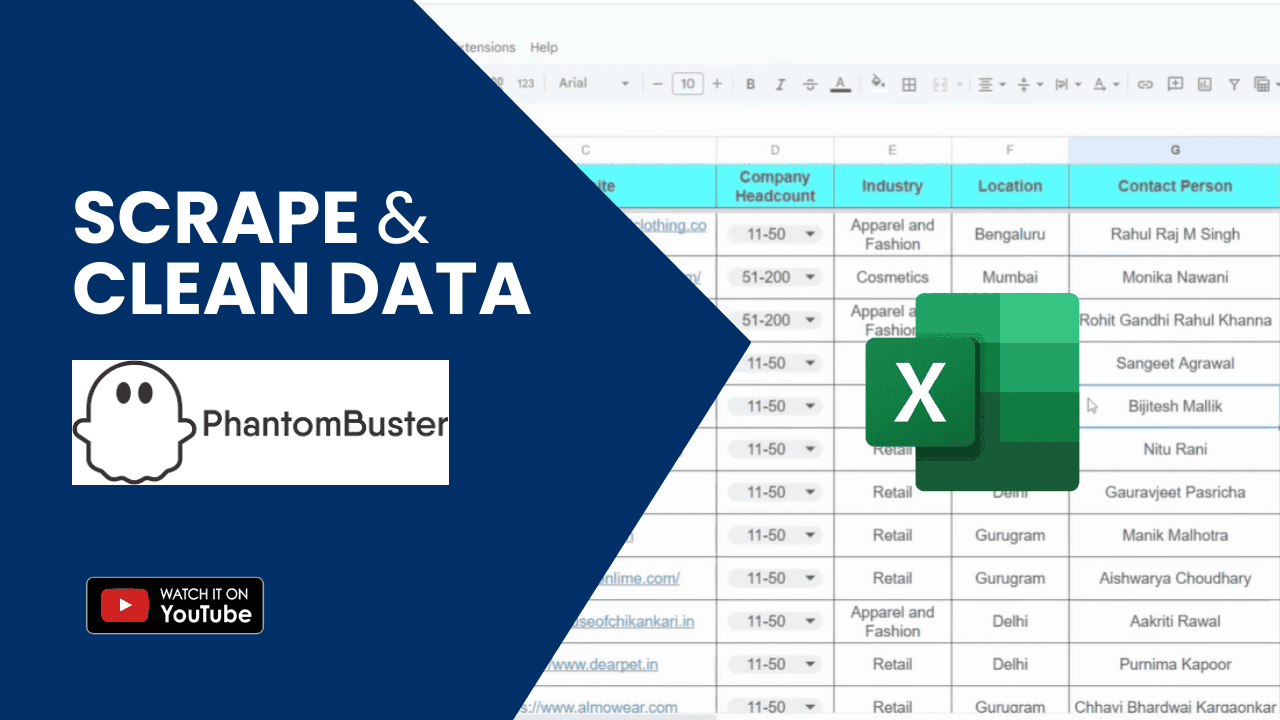
Once you've scraped your data, you're inevitably faced with duplicate entries, inconsistent formatting, incomplete data fields, and outdated information. The CRISP-DM model calls this the data preparation phase—and it's often the most dreaded task in the process. Sales data comes in high volumes, and resources are typically limited.
This is why your cleaning process needs to be methodical and efficient:
Start by limiting the data to fields you actually need. Don't waste time cleaning information you'll never use. Focus on the essential fields—company name, contact details, relevant firmographics, and any specific data points tied to your business problem.
Assess data completeness across your prospect list. Identify which critical fields are missing for which prospects. Eg: A record without an email address or decision-maker name.
Fill gaps strategically using additional data sources. Can you enrich missing fields by running targeted scrapes with different tools? Sometimes a second pass with a specialized tool can complete records that your initial scrape left incomplete.
Standardize formatting for easy usability. Ensure consistency in how company names appear, how phone numbers are formatted, how job titles are written. This prevents the same company from appearing multiple times due to formatting variation.
Segment and categorize your data for analysis. Group prospects by industry, company size, geography, or any criteria relevant to your sales strategy. This segmentation allows you to identify patterns, and prioritize outreach.
The output of this phase should be a clean, standardized, enriched dataset where every record contains the minimum viable information needed for outreach, and where you have confidence that the information is accurate and current.
Making sense of it all: The Modelling and Evaluation Phase
Here, you analyze your cleaned prospect data by building frameworks that can help guide your sales strategy.
It begins by determining which methods will help you extract meaningful insights. This could mean:
- lead scoring to prioritize prospects with similar company size, growth stage or industry, location
- sales cycles to check operational efficiency, SDR performance or some other point of analysis.
Depending on your objective and approach you will need to split your data strategically and then apply the chosen method to the data.
For instance, if you are ranking leads, the next step would be to score leads based on weighted criteria (company size, industry, tech stack, engagement signals).
This execution is often straightforward. The value, however, lies in what you choose to analyse and how you interpret it. Which brings us to the last point before deployment—sales data evaluation.
The evaluation phase looks more broadly at whether your framework actually meets your sales objectives and what to do next.
This means asking whether your lead scoring model helped you identify better leads? What category of leads are converting at a better pace? You can also leverage AI tools to rapidly test multiple models against each other.
In our latest post, we show how sales heads can use Clay’s AI-Sculptor to review the performance of SDRs with questions like: Which SDR has the highest meeting volume with a particular type of company?
Based on your evaluation, decide whether the model can be deployed for continued results, iterated and refined further or pivot to a different approach entirely.
