
Communities are not built for selling. Most people agree to this in principle, but few manage to execute it well.
There isn’t a group of enterprise buyers sitting inside a Slack community, scrolling through messages in search of a product or service. That’s simply not the nature of any healthy community.
Roughly 3–4 months ago, we started actively participating in Sales and GTM Slack communities.
The intent was straightforward: get closer to the global GTM ecosystem, understand how go-to-market thinking is evolving across geographies, and share the workflows, playbooks, and experiments we were already documenting through videos on our YouTube channel. And if you’ve been following along, we recently crossed 300 subscribers. A meaningful portion of whom came directly from the communities we chose to spend time in.
That said, there are moments when our content gets flagged in some communities 🚨— as recently as this week, in fact. And mind you, this was a genuine mistake, which I corrected by deleting the post at the earliest.
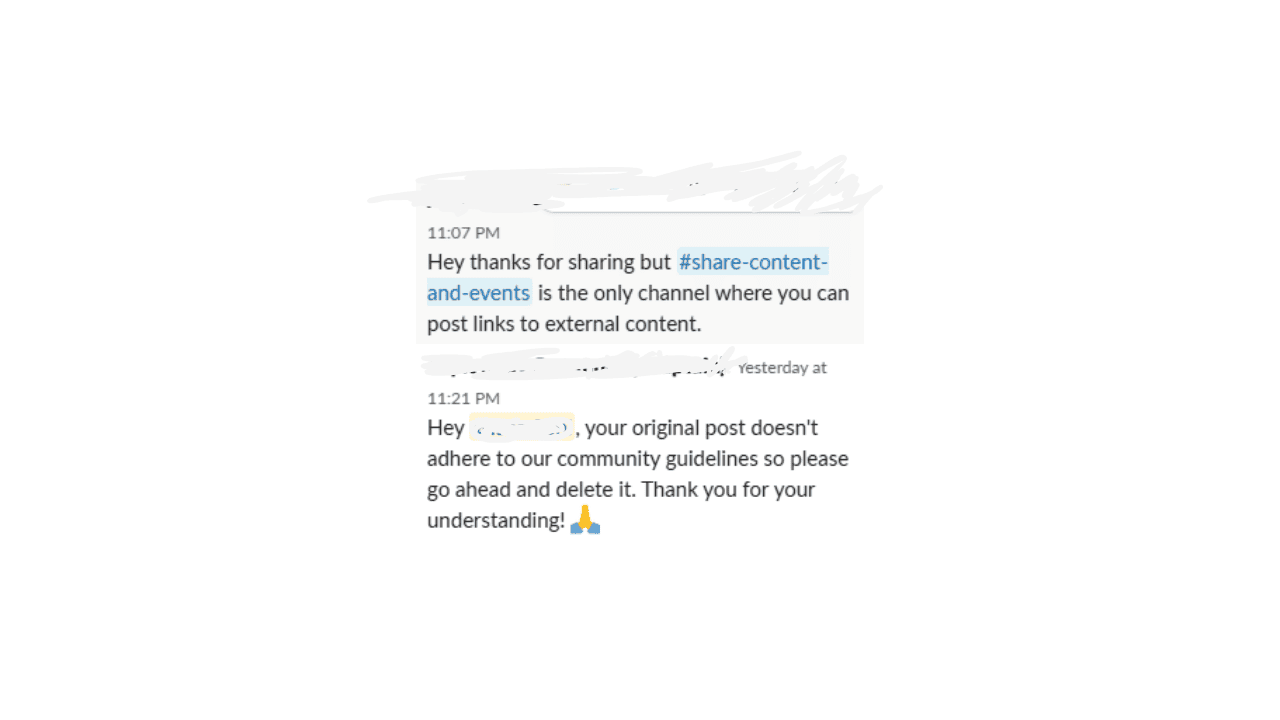
To many people’s surprise, this does not lead to expulsion (except in cases of repeated spam). No one is removed for honest mistakes, though there is never a shortage of people attempting to use communities as marketing platforms.
In large, open communities, judgement can slip surprisingly fast. Over the past few months, we’ve closely observed Slack communities and experimented thoughtfully. At times, the outcomes were baffling, even to us. And this seems to be true for most people who engage deeply and consistently in community spaces.
That led us to spend time studying how Slack communities can be used to drive personal and business growth. The insights felt valuable enough to share more broadly.
Joining Slack Communities
How do you decide which Slack communities are worth joining?
There are many Slack communities out there with real, consistent engagement—where people are participating, sharing insights and helping each other. Similarly, some communities look promising on the surface, especially based on member count but you realize they are largely dormant, once you join.
Yet choosing the right community isn’t as simple as joining the most active one.
It is important to assess what you have to offer. And that’s rarely the product / service you are selling. You need to ask yourself what unique input can you provide to the system?
Communities naturally elevate people who reduce confusion, clarify trade-offs, or make complex problems easier to reason about. If you don’t have a clear source of differentiation, you’ll struggle to stand out in conversations that already have plenty of surface-level opinions.
The odds start tilting in your favor when your community choices are grounded in realities you know best.
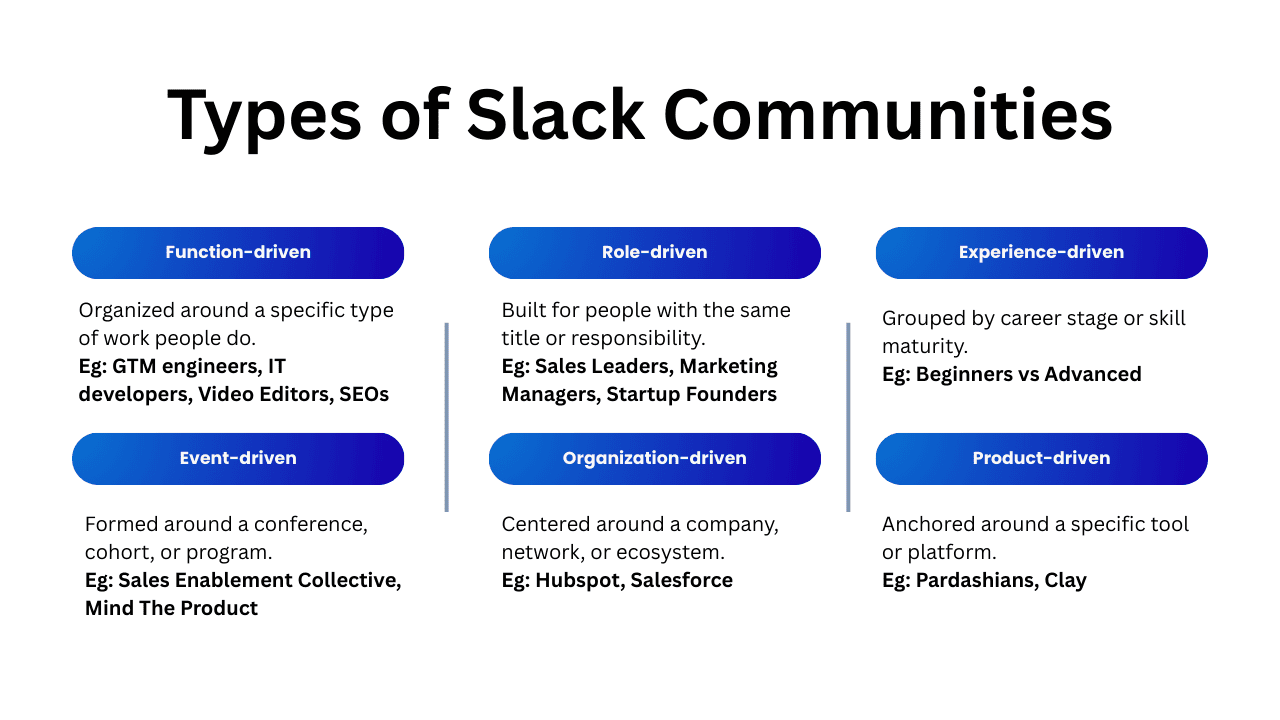
Start by diving deeper into your function—the work that you actually do on a day-to-day basis. Unlike corporate designations, communities tend to cluster around functions and also break out around it.
Then you have to be sure that the community is of people from (or working for) the industries and locations you cater to.
Ensure you have the appropriate decision-makers or at least people with the power to influence decisions.
Now let’s ground this with examples. Shall we?
In sales, RevGenius is a very well known community. A significant portion of RevGenius members are SaaS founders selling into the US and UK markets. This is the anchor point from which the community naturally breaks out into channels that allow members to chat about early-stage GTM, sales, founder advice, tool feedback, hiring, and even pitch their services directly.
[ Community Link ]
Contrast this with GTM Cafe by Kellen. It is on the very functional end of sales, in a sense that the community is heavily skewed towards practitioners working directly on GTM systems. It is a free-flowing GTM operator chat centered around AI tooling, and outbound infrastructure, mixed with real-time troubleshooting, occasional memes, and community banter.
[ Community Link ]
Similarly, Sales Enablement Collective’s SEC Slack channel centers squarely on the Sales Enablement function. It is designed for members to openly discuss enablement strategy, programs, content, training, and career growth. Consequently the space is divided into channels like budget, events, coaching, content, etc.
[ Community Link ]
Clay’s Slack community naturally orients around product-adjacent learning. Unlike broad sales, the community focuses on doing the work—building outbound systems, enrichment workflows, and scalable GTM engines using Clay at the core. But occasionally, conversations extend into other tools and practical experimentations.
[ Community link ]
Neither community is “better.” They simply optimize for different realities.
The question that follows is ‘How do you assess all this before joining?’
Community descriptions help but they’re not enough.
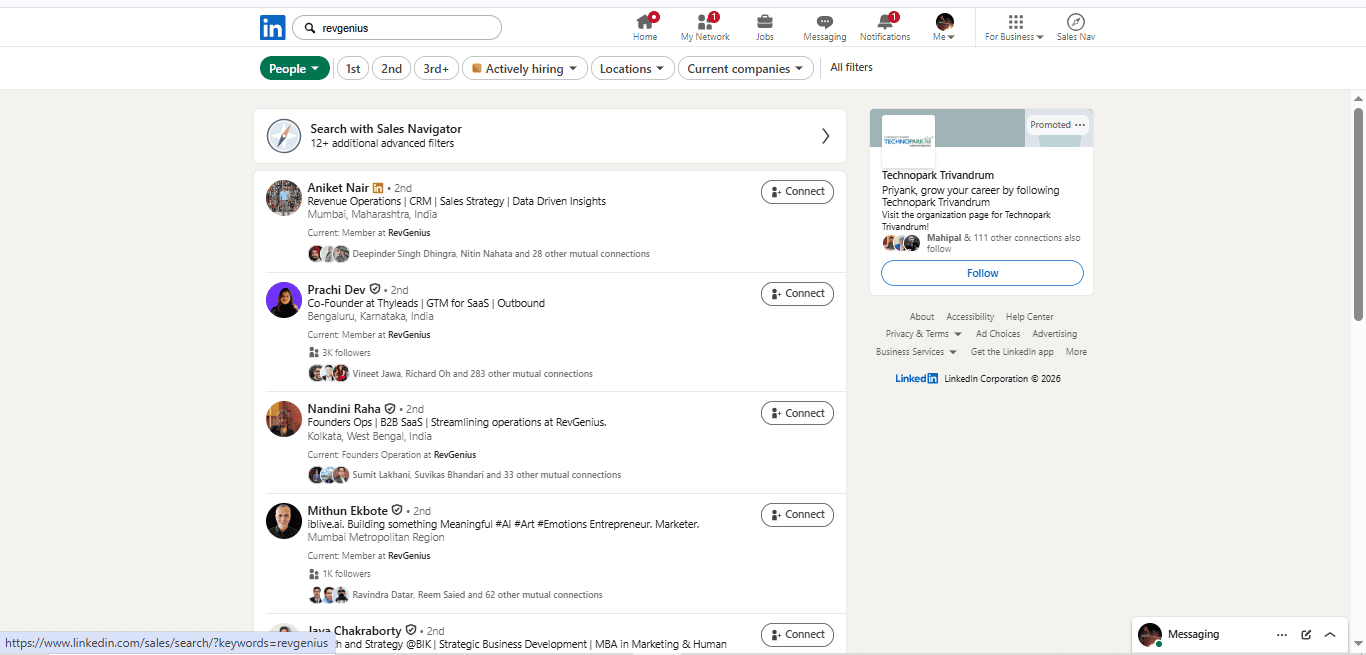
A more reliable approach is to look at who the members are. Many people list Slack communities on their LinkedIn profiles. Search for the community name on LinkedIn and scan the profiles of people who mention being members.
Navigating The Community
What to do once you’ve joined a Slack community?
The answer is less glamorous than expected: don’t speak yet. You’d be better off understanding how the place works.
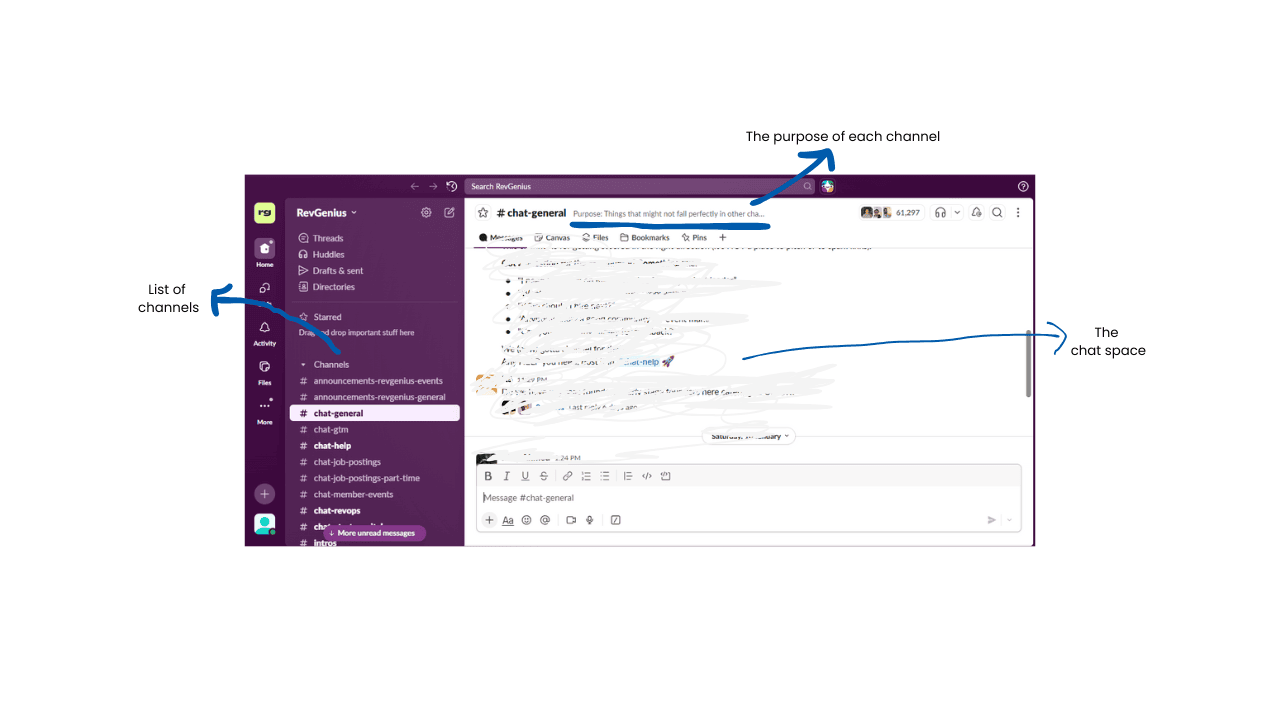
Slack communities almost always have some form of structure:
A community manager or core group of moderators
Clearly defined guidelines around posting and engagement
Intent-based channel separation (questions, resources, jobs, off-topic, etc.)
Spotting these elements early tells you how the community actually functions.
Pro tip | If you don’t see a channel you expect, search for it. The list of all public and private channels is available under directories on the top left.
Before posting anything, deliberately spend time to understand:
Where do people ask questions vs. share insights?
Which channels tolerate long-form posts, and which reward brevity?
Where do links perform well, and where are they ignored?
What tools, frameworks, or ideas get repeated traction?
What topics consistently trigger replies?
When are threads most active?
Taking time to understand the structure, norms, and rhythms of a community allows you to enter with context. When you eventually speak, your contributions land better and build credibility faster.
Engaging Within The Community
Like any other platform, participation in communities should begin with the outcome in mind. Depending on what community and channel you are engaging in, you can expect credibility, collaboration, referrals and if you play by the rules, you can also secure a business deal eventually. What you are looking at is a long game but not an unwinnable one.
To influence your slack community outcomes, you just need to focus on four primary approaches:
Answer questions posted by members
Ask a genuine query
Share business insights
Share valuable information
Answer questions posted by members
Answer questions posted by members
Answering questions within a community is the most direct way to build credibility, but it only works when the answer is genuinely insightful rather than written by ChatGPT. Communities are built around shared problems, and consistently solving those problems position you as a reliable operator rather than a vendor. Over time, with repeated high-quality answers, members begin to associate you with clarity and competence in a specific domain.
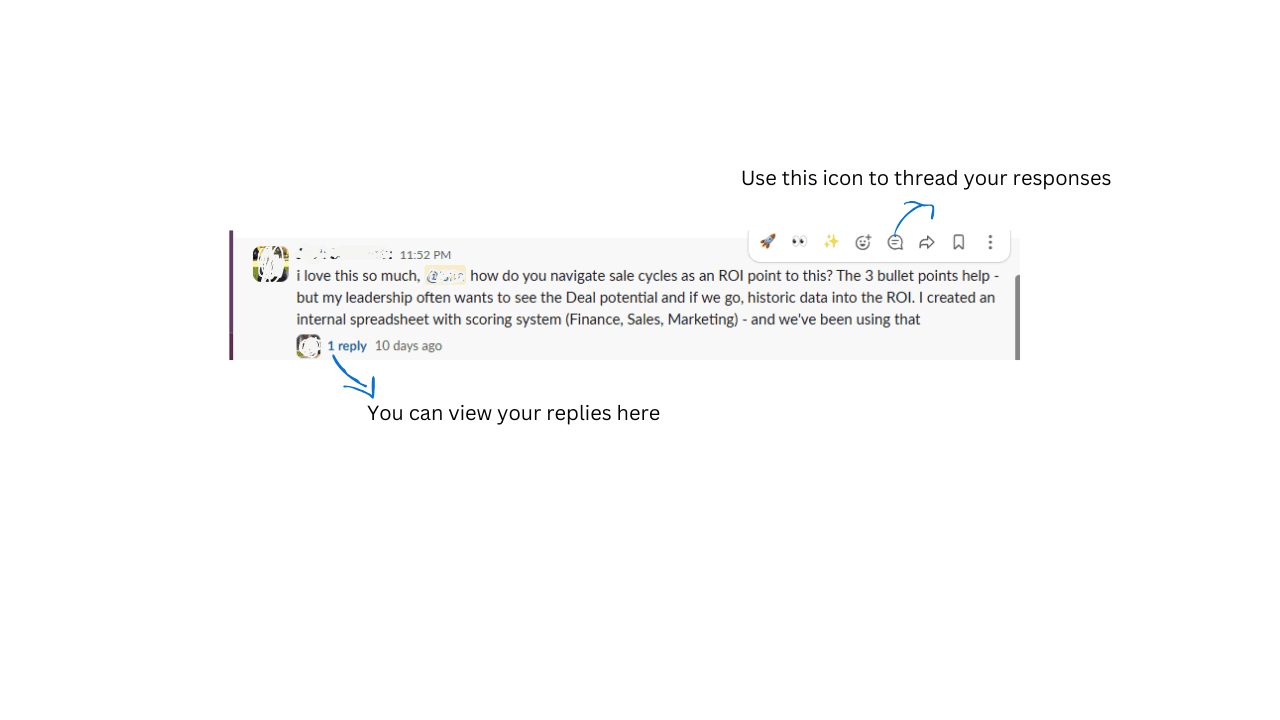
But make sure to thread your response instead of posting it openly.
2. Ask a genuine query
Asking thoughtful questions is an underrated community strategy. Genuine queries signal curiosity, openness, and interest in the collective upliftment of the group. Well-framed questions also help you learn how the market thinks. What is it that people prioritize? Where do they disagree? And which problems are still unresolved?
There are a few things to keep in mind when framing a question in a community.
Be explicit about the problem you are trying to solve. State the context clearly so people understand why you are asking.
Do not assume shared knowledge. Avoid jargon, internal references, or shortcuts.
Keep the structure simple. Do not bundle everything into a single paragraph.
Use short sentences. Leave space between thoughts so responses are easier to follow and engage with.
3. Share business insights
The goal here is not to narrate everything you built but to transfer an idea. The attempt should be to help others rethink how they can approach a problem even if they do not replicate your exact setup. It helps others shorten their learning curve and establish you as someone who operates at a strategic level.
4. Share information
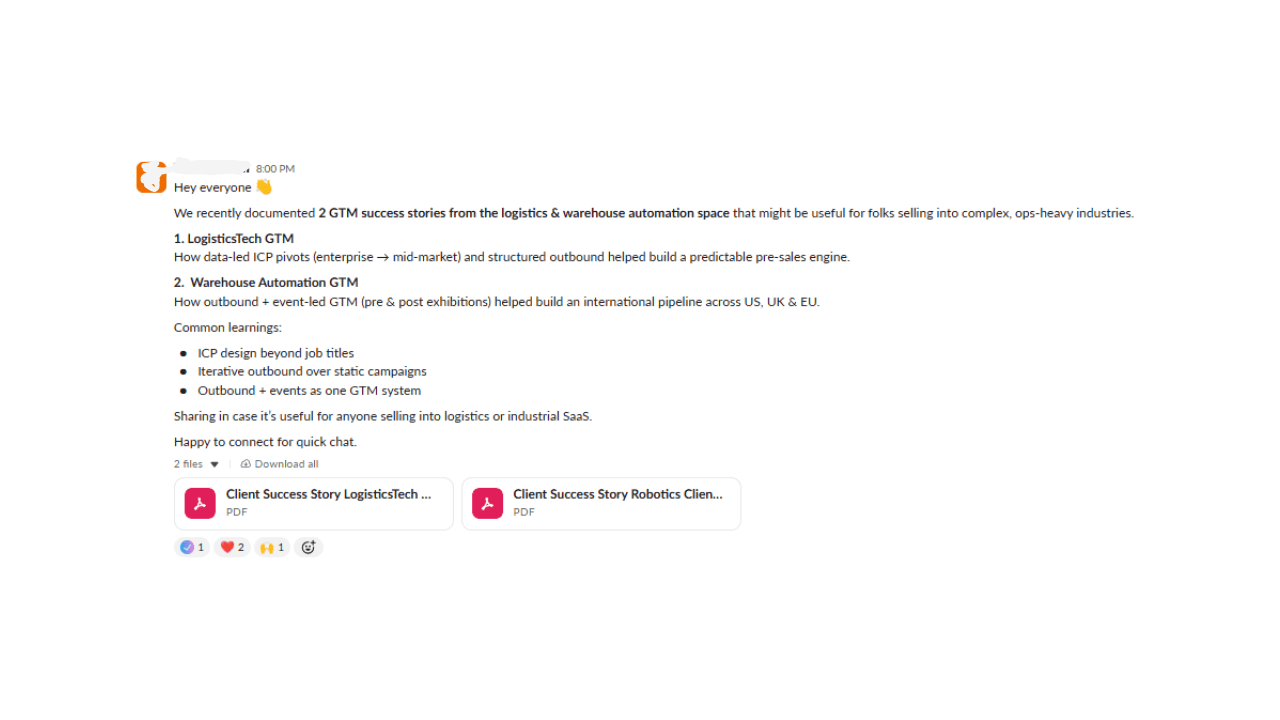
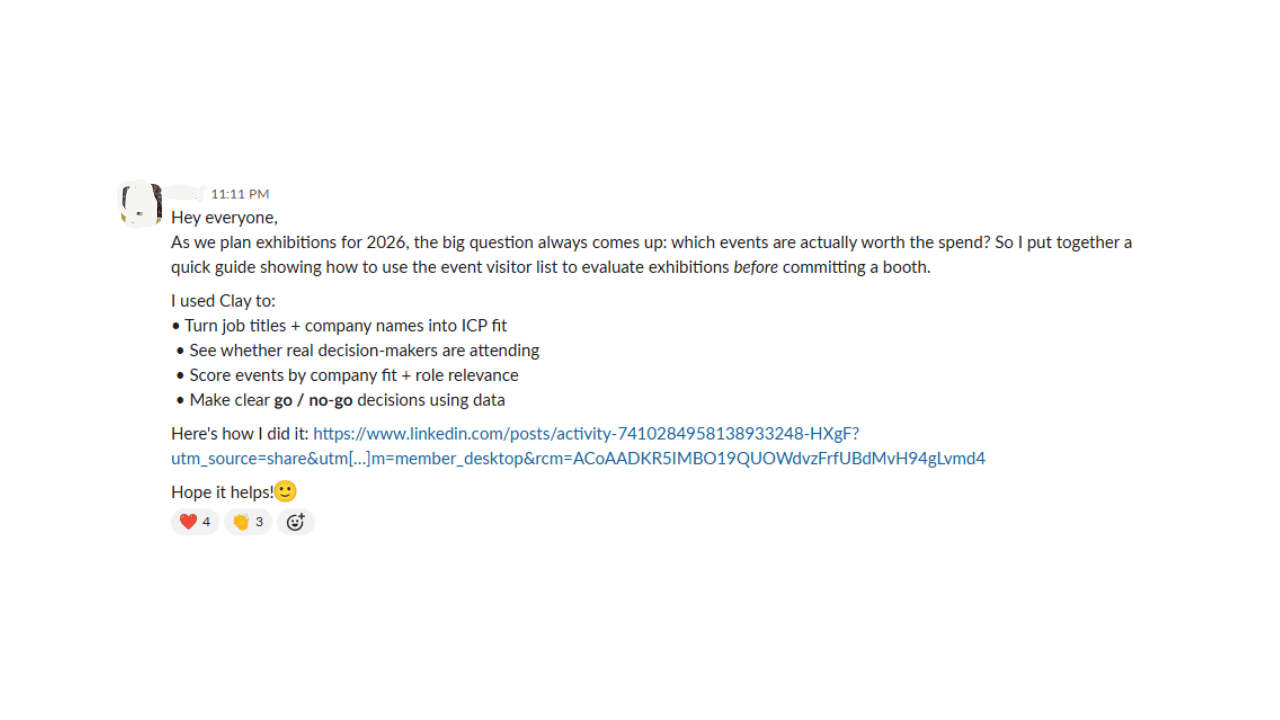
This could be a benchmark report, a framework, a workflow, or a concise summary of a longer piece of content. The value does not come from the link or the document itself, but from why it matters and how others can apply it.
However, before sharing, it’s important to understand the norms of the community. Some slack communities have dedicated channels for external links. Respecting community guidelines ensures that your contribution is received as helpful rather than promotional.
And finally cut some Slack! (not too much!)
It’s easy to assume that communities require constant availability. “I will have to be online at all times, respond instantly, and maintain a polished, professional tone.” In reality, that mindset often works against you. Communities are not service desks, and credibility does not come from speed or perfection alone.
Community benefits are reaped on sustained participation, not real-time vigilance. It’s okay to step away and engage when you have something thoughtful to add.
Afterall, this is not just about growth hacks or lead generation. It is also about proximity to good thinking. Over time, that proximity shapes how you think, what you build, and who you build it with.
We’re still early in this journey. But it’s clear that the real value of communities isn’t what you extract from them. It is who you become by staying in them long enough.
And we’ve only begun!