
It is nearly impossible to go a day without hearing GTM engineering in sales conversations. Those who are privy to it, know how it is being utilized to plan, execute and scale outbound sales.
Across Slack communities, online forums, and WhatsApp chats, global sales professionals and RevOps are actively sharing playbooks on building the right GTM strategy and tech stack.
But for all who know, there are just as many who are still in the dark about what it is and how it works. For them, outbound still remains tool-heavy, manual and difficult to scale.
The start of a new year brings an opportune time for sales professionals and founders to understand what GTM engineering really is, why it matters for outbound sales, the advantages it can unlock for forward-looking businesses, and what it takes to stay ahead in this fast expanding market.
What is GTM Engineering?
GTM Engineering is the discipline of strategizing and designing a company’s go-to-market operations. Think of it as the bridge between building a product/service and building a scalable business.
A GTM engineer helps define who to sell to, what to sell, how to sell, and how to scale, then engineers those decisions into automated, data-driven systems.
Rather than treating strategy and execution as separate phases, GTM Engineering follows an engineer-as-you-grow approach: strategy is expressed as logic, workflows, and infrastructure from day one.
Systems continuously collect leads using input logic, enrich them with relevant data, create personalized messages, and automatically take action (like outreach). This helps turn your go-to-market strategy into a structured, repeatable growth engine that helps companies win customers faster than competitors.
What GTM Engineering isn’t.
GTM engineering is not just about stacking tools and connecting APIs, hoping they bring in results. Simply connecting a CRM, outreach software, and AI tools does not create a system.
One needs to understand business strategy, make a clever choice of tools and clearly define workflows to keep the data reliable and prevent the system from breaking at scale.
When does GTM engineering become necessary?
Like the abbreviation goes, GTM engineering becomes necessary as soon as you plan to take your product / service to the market.
When your GTM is engineered upfront, even simple motions can be automated, measured, and improved from day one. Turn this on its head, and you can say that the way a company engineers its GTM motion can itself become a competitive advantage.
However, GTM engineering typically becomes applicable when:
- Outbound can operate on defined inputs and rules.
- Outbound can operate on defined inputs and rules.
It is when your ideal customer profile (ICP) is well-defined but difficult to reach and engage with across channels. GTM motions can coordinate the signals into a single, automated workflow.
2. Teams can’t fully own orchestration
Sales and marketing understand buyer intent but lack technical orchestration skills. IT and Dev can build systems but lack context on the customer journey. GTM motions bridge the gaps between these.
What is the advantage of GTM engineering for businesses?
All the capabilities you need to strengthen your customer journey can be realized with GTM engineering:
Custom AI Agents: Automate prospecting, outreach, or customer engagement.
Signal-response systems: Capture and act on buying intent or customer behavior in real time.
Orchestrated touchpoints: Coordinate email, social, events, and product interactions seamlessly.
Integrated workflows: Tie all your systems and data together for transparency and efficiency.
These capabilities make your outreach unique, hard for competitors to copy, and give your company a clear competitive edge.
Misconceptions about GTM engineering
It is only needed when launching a new product. GTM engineering is valuable at every stage of a business. For large enterprises, the necessity is even more pertinent. The larger the scale of operations, the greater the advantage of having an automated, intelligent GTM system that captures, analyzes, and acts on data in real time.
It is overcomplicated and requires too many tools.While GTM engineering might involve multiple systems, the goal is to integrate them into a streamlined workflow. The complexity comes from orchestration, not tools. With proper setup, the process becomes efficient, not burdensome.
It is entirely automated with no need for manual oversight. Even the most advanced GTM motions require human guidance for strategy, quality checks, and decision-making. Automation handles repetitive tasks, but humans remain critical for decoding the problem with the most optimum use of tools, and ensuring the system delivers the intended outputs.
How we use GTM engineering to help businesses grow
We don’t just advise businesses on improving their go-to-market operations—we build and run GTM engineering ourselves to drive real growth for the companies we work with.
For example, we partnered with an emerging BNPL fintech and NBFC that was exploring a B2B2C expansion. Their critical challenge was identifying where durable demand and decision-level buying intent truly existed. Rather than prescribing an ICP upfront, we embedded ourselves into their GTM motion. We ran structured experiments across multiple industries and founder profiles. By joining live sales conversations and tracking real buyer behavior, we helped the team identify a clear ICP with strong adoption and revenue potential. We then turned these learnings into a repeatable LinkedIn-based acquisition system that consistently generated qualified meetings, improved deal quality, and created a predictable pipeline.
Want to know the exact steps? DM me or Vrutant Shah to access the full case study.
Resources to dive deeper into GTM architecture and motions
All that you need to understand GTM engineering is available on our YouTube channel and LinkedIn guides.
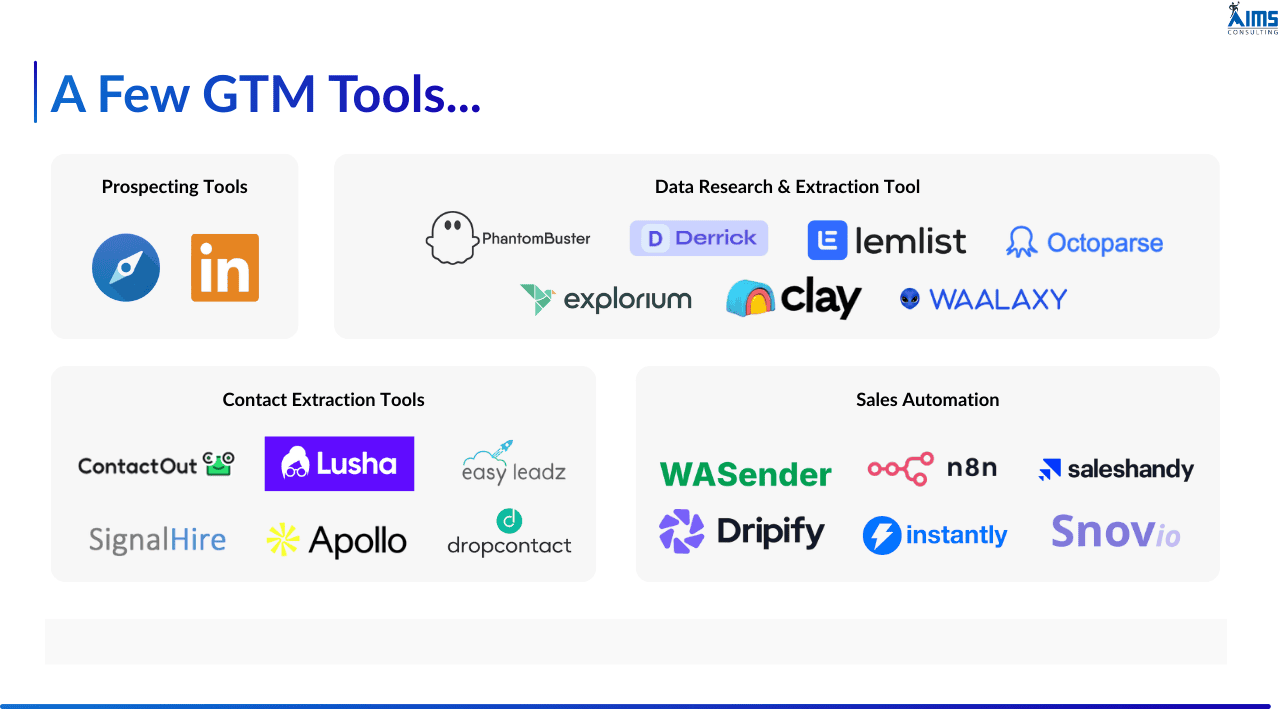
- Tools: The most effective platforms for building an autonomous GTM motion.
- Frameworks: Proven models and structures that help perform market research.
- Workflows: Step-by-step examples of how to connect data, automate actions, and trigger the right outreach at the right time.
- Use cases: GTM engineering to solve real business problems.
If you need further assistance or clarity, reach out to us at marketing@aimsconsulting.in